
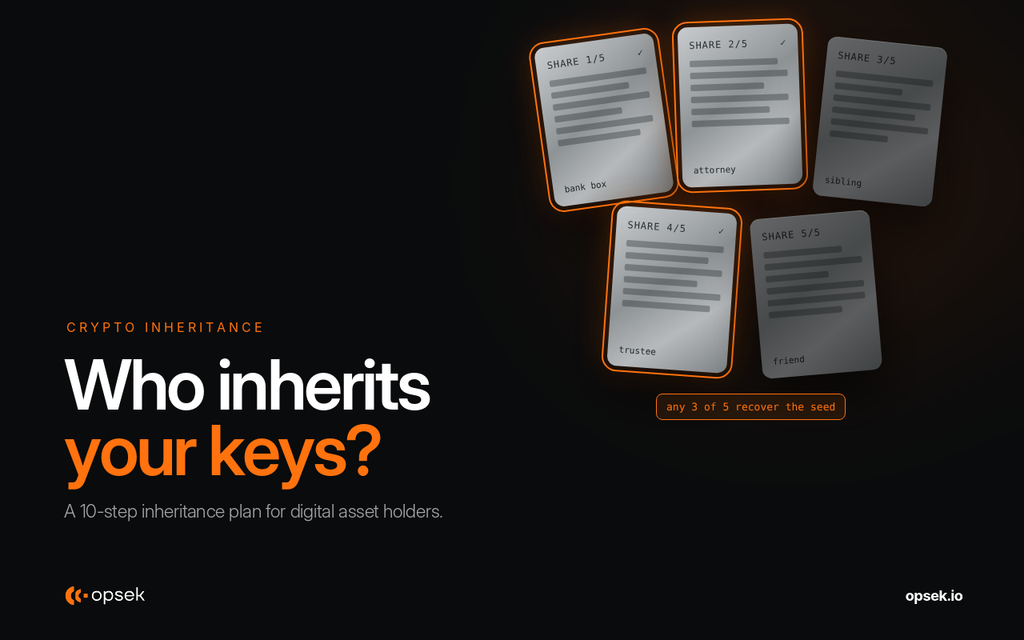
If something happened to you tomorrow, would your family know which wallets you hold, where the keys are, and how to use them?
For most people, the answer is no. Assets are spread across banks, exchanges, apps and wallets, and the will sits in a drawer nobody knows about. A death kit solves this: everything your family needs to take over, from a list of your assets and the legal papers that pass them on, to the logins, recovery paths, emergency cash and original documents.
Digital assets raise the stakes. With a bank account, a family can usually reach the money with a death certificate and some patience. With self-custody, there is no institution to call: if nobody has the keys, the funds are lost for good.
The catch is that a kit that helps your family can help a thief just as much. This guide is for anyone with digital assets or people who depend on them. First, we look at who you need to protect your family from. Then we walk through ten steps to build a kit that stays safe while you are alive and easy to reach when you are gone.
The guide builds on the death kit concept covered by privacy researcher Michael Bazzell in UNREDACTED Magazine, adapted for digital asset holders.
This is a blog post for general information, not legal, tax or financial advice. Tools named in this guide are examples, not endorsements.
Three adversaries
Every security plan starts with a threat model: what you are protecting, and from whom. Most inheritance plans answer the first question in detail and never ask the second.
- The outsider. A stranger who finds out that you hold crypto, or that your family just inherited it, through obituaries, court records, people-search sites or a wallet linked to your name: a robber planning a home invasion, a phishing crew, or a fake "recovery service" that targets grieving families.
- The insider. Someone close to you, like a relative or a member of your staff, who can reach your seed phrase, your devices or your passwords before your heirs need them.
- Time. Nobody attacks, but the plan breaks on its own: a hardware wallet dies, a passphrase is forgotten, forms get outdated and accounts get frozen.
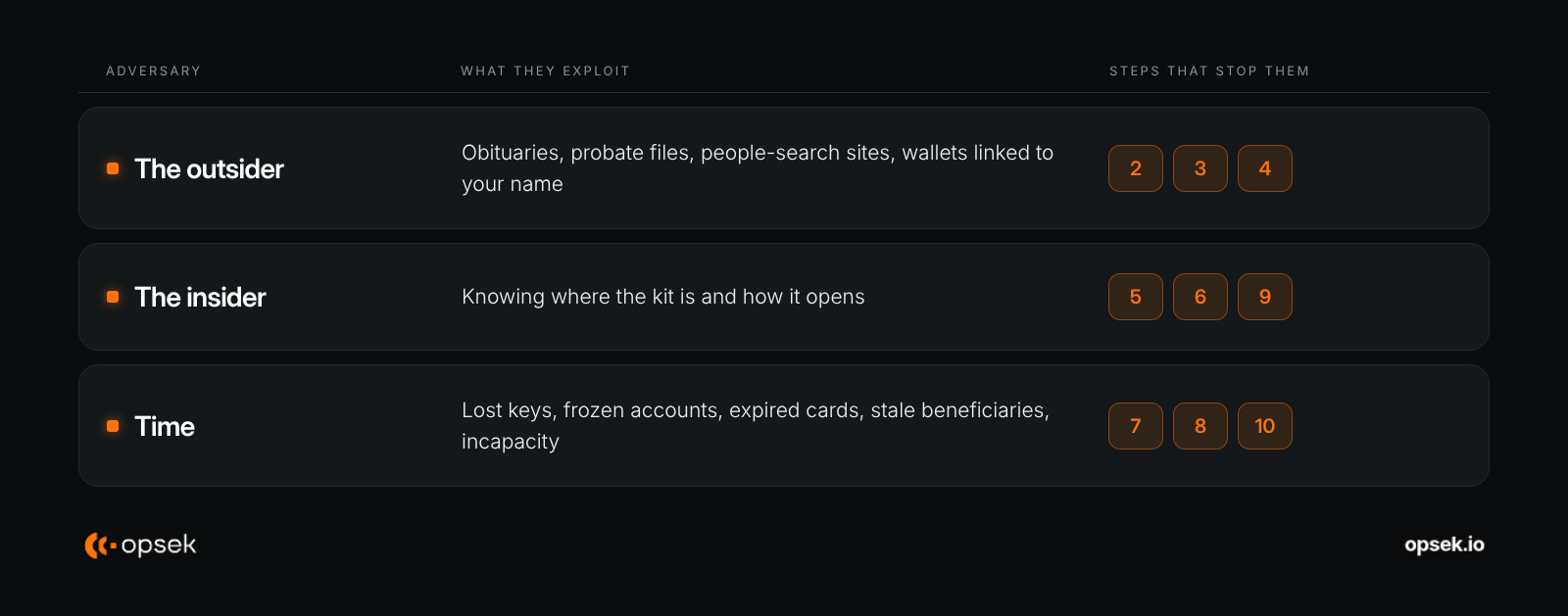
Traditional estate planning handles part of the third, and helps with the first only by accident. Here is the full roadmap; step 1 is the foundation for the rest.
- Map what you have
- Control what goes public
- Keep assets out of probate
- Choose and protect the trustee
- Build a delayed path to your accounts
- Put a time lock on your crypto
- Keep the bills paid
- Plan for incapacity
- Store the originals
- Review it every year
Step 1: Map what you have
Everything else depends on a complete list, and digital assets are the easiest to lose track of. They sit across exchanges, devices, apps and chains, and heirs cannot claim what they do not know exists.
- List every exchange and custodial account, with the email it is registered to.
- List every self-custody wallet: which device or app holds it, which chains it is used on, and whether it uses a passphrase. Add every multisig, its signers and its threshold.
- Add what is easy to miss: staked or locked tokens, DeFi positions, vesting schedules, NFTs, ENS names and domains.
- Add the accounts that unlock everything else: your email, phone number, password manager and 2FA app, plus any business account only you control.
- Then list the traditional assets that must be inherited, kept running or shut down: homes, vehicles, bank and brokerage accounts, retirement accounts, insurance policies, company stakes, valuables, utilities and recurring payments.
- Document every privacy layer. For each trust, LLC, alias, virtual card or mail drop, write one line on how it works and who else knows about it.
- Keep the inventory without balances. List what exists, so heirs know what to look for but cannot move anything. Keep addresses and extended public keys behind the delay in step 5: they show every balance to whoever reads them.
- Name a successor for each item, and a backup for that person.
- Collect your professionals' details: name, address, phone and email for every attorney, accountant and advisor you work with. Someone will still have to file your last tax return, and an accountant who already knows your crypto history makes that far easier.
Step 2: Control what goes public
Adversary: the outsider.
A traditional obituary publishes the full names of the spouse and children, the cities where they actually live, and how every sibling, niece and nephew is related. People-search sites scrape obituaries and append that data to the survivors' profiles, so a relative who has worked hard to keep their address private can end up listed next to the rest of the family.
The same map has a second reading. It tells an attacker who just inherited, or soon will, and where they sleep. For a family known to hold crypto, that is an invitation.
- Sign a final arrangements document, separate from the will, because a will is often read weeks or months after death, long after the obituary has run. Name one person in charge and set the rules: a death notice in a single newspaper, no locations of family members, no details about the funeral or other services, no residential, employment or hobby history, and no announcements on social networks, crypto forums or group chats. It is not filed with any government office, but have it signed in front of witnesses.
- Walk your family through it now, so they are not reading it for the first time during the funeral week.
- Never tie a wallet address, an ENS name or a balance screenshot to your real name. Once that link exists, your balance is public, permanently.
- Check what is already public about your family. An attacker starts there, and so will any journalist writing your obituary if you are publicly known. Our post on preventive OSINT explains how.
Step 3: Keep assets out of probate
Adversary: the outsider.
In the US, a will does not avoid probate; it is the document that triggers it. Probate is a public court proceeding, and in most states the case file is open to anyone, often including an inventory of the estate (rules vary by state). Some data vendors pull new filings county by county and sell them to real estate investors as monthly "probate leads," complete with the executor's name, address and phone numbers. An inventory that lists crypto tells the whole county who just inherited it. If you own real estate in more than one state, each of those states can require its own probate case, called ancillary probate, with its own public file; property held in a trust avoids it.
Probate takes time. Even a simple case with no dispute can run for months, and until it closes, the family may keep paying for a house it cannot sell. Assets in a funded trust skip all of that: the successor trustee can act right away. Avoiding probate is legal and common. It does not avoid estate taxes or debts; it keeps the process private and fast.
Options to discuss with your attorney:
- Payable-on-death (POD) beneficiaries on every bank account, with a primary and a contingent rather than just one. A sole beneficiary who dies before you will likely send the account to probate.
- Transfer-on-death (TOD) beneficiaries on investment accounts until they move into the trust.
- A revocable living trust with a generic name for investments, savings, certificates of deposit and vehicles, with brokerage assets transferred in kind so nothing is sold. Ask how to hold digital assets in it: exchange accounts can often be retitled, but self-custodied crypto has no title, so the trust's documents have to state that the trust owns it.
- A separate trust for each home, with a generic name and someone else as trustee, rather than the living trust, where you are usually the trustee, and not mixed with other assets. Privacy guides also suggest keeping words like "living," "land" or "property" out of its name. If the trust buys the home, your name never appears on the deed. Moving a home you already own into it still avoids probate, but the earlier deeds carry your name, and the transfer deed links you to the trust. For a crypto holder, a home address that cannot be found is one of the strongest defenses against a physical attack.
- Funding the trusts. Writing an account number on the trust's schedule does not move the account; it has to be retitled in the trust's name, or a new deed recorded for a house. The same applies to every account, wallet, property or company stake you acquire after the trust is signed. An empty trust is a common way this plan fails.
- Covering the contents. Instead of itemizing, the trust's schedule can list "all household items" at the home's address, and the safe "and all contents."
- A certification of trust, so exchanges, banks, county offices and other institutions can confirm the trust exists without seeing its assets or beneficiaries.
- A will as a safety net, with an executor and an alternate, two witnesses who are not beneficiaries, and shares that add up to exactly 100%. A will whose shares total 110% leaves a judge to decide what you meant. Never write a seed phrase, a password or a wallet address in it: a will can become public.
Step 4: Choose and protect the trustee
Adversary: the outsider.
A privacy trust only works if nobody can trace the trustee back to you. The trustee's signatures on the closing documents are recorded at the county level, and they will usually know your address. That makes the trustee the weakest link: a social engineering attack on them can undo years of privacy work.
- Search your name and the candidate's on people-search sites, and check whether the two connect.
- Choose for distance. A relative is the easiest choice and the most linkable; a different surname helps. A friend only works if there are no photos of the two of you online. An estate attorney costs more and gives the most privacy: they are bound by attorney-client privilege. Ask them how liability for the role would be handled.
- Apply the same test to your advisors. A family office executive or private banker whose public profile already ties them to you is as linkable as a cousin.
- Make sure the trustee, or someone they can call, understands self-custody. A trustee who has never used a hardware wallet can be talked into giving a seed phrase to a scammer.
- Name a successor trustee.
- Secure the trustee like a multisig signer: a hardware key on their accounts, a social engineering briefing, and a way to verify any request that claims to come from you.
Step 5: Build a delayed path to your accounts
Adversary: the insider.
A recovery phrase, a password file or a safe prepared for your heirs is exposed from the day it exists, not from the day you die. The people best placed to reach it are the people closest to you, and in a household with staff, that circle goes beyond the family. A PIN on a hardware wallet does not change this: anyone with the recovery phrase can rebuild the wallet on another device.
The answer is isolation plus a delay: a separate vault with only what heirs will need, behind a waiting period you can veto. One way to build it is a paid Proton account opened in the name of your trust and protected with a hardware key.
Proton's Emergency Access lets up to five trusted contacts, each with their own Proton account, request access. Proton notifies you, and you can deny the request. If you do not, access opens automatically when the waiting period ends. The longest wait Proton offers is 30 days.
The most tempting shortcut undoes the whole design: the account password on a card in the home safe, with the hardware key right next to it, just in case. With two ways in, you are only as safe as the weaker one. An intruder who would otherwise have to take over a family member's Proton account, request access and wait 30 days gets in the moment the safe opens.
Design for a broken promise, not just a funeral.
- Build a separate vault with only what heirs need: the logins for your exchanges and email, the logins tied to the trusts, the homes and your finances, plus the 2FA seed for each, and your wallet addresses and extended public keys from step 1. A paper list of passwords will not get anyone past 2FA or new-device checks.
- Plan for your phone. If your 2FA codes arrive by SMS or live in an app on a locked phone, your heirs are locked out too. For accounts that use an authenticator app, store the 2FA seeds in the vault. For accounts protected with a hardware key, register a backup key for your heirs and record in the vault where it is kept. Keep your phone's unlock code there too.
- Tell your heirs where the vault is and how it opens, but give nobody the vault itself today.
- Prepay the account for years, and set the longest wait you can live with.
- Remove every physical shortcut around the delay. If you want a fallback, split it: the password in one place and the hardware key in another, held by different people, so no single place or person holds a complete login.
- Make sure you will see the request. Proton's help page says it notifies the owner of every request, but not through which channel. If the vault account does nothing else and you check it twice a year, the 30-day veto is no veto at all. Find out where the notice lands and make sure it reaches something you check daily. One way is to make the vault account the mailbox for the utilities and providers tied to your trusts, so you open it often.
- Secure your emergency contacts like signers. Each contact's Proton account is now a door into yours, so give each one a hardware key and the same phishing briefing you would give a multisig signer.
- Decide what dies with you. Sort your data into three piles: what dies with you (encrypted, with a password nobody knows), what is open, and what is sensitive but inherited (encrypted, with the key only in the heirs' vault). Personal and work email can die with you too; set up forwarding now for any work address colleagues will still need.
- Set up the legacy tools that already exist: Google's Inactive Account Manager and an Apple Legacy Contact. Apple's does not include your iCloud Keychain, so it will not hand anyone your saved passwords.
- Keep it simple enough for your least technical heir. Security cuts both ways: every hurdle you add raises the odds that nobody ever gets in.
Step 6: Put a time lock on your crypto
Adversary: the insider.
A password manager is the right place for your logins, but not for your seed phrases. Whoever holds the keys holds the funds, and a seed stored in the same vault as everything else turns a single breach into a total loss.
Wallets and standards built for recovery and inheritance enforce the delay or the split in the protocol itself.
- Make sure no single person, safe or file can move funds alone.
- On Bitcoin, add a timelocked recovery path. Liana adds one to every coin: your primary key spends normally, and a recovery key, held by an heir or a professional, only becomes valid after a period you choose. A stolen recovery key is useless until the timer runs out, and every time you move your coins, the timer restarts.
- On Ethereum, use a recovery you can cancel. With Safe's account recovery, a recoverer you designate can propose replacing the signers, but the proposal must wait out a delay, 28 days by default. During that time, the current signers can cancel it.
- For a multisig, make sure your heirs can reach enough signers to meet the threshold without you, and that no single heir can meet it alone.
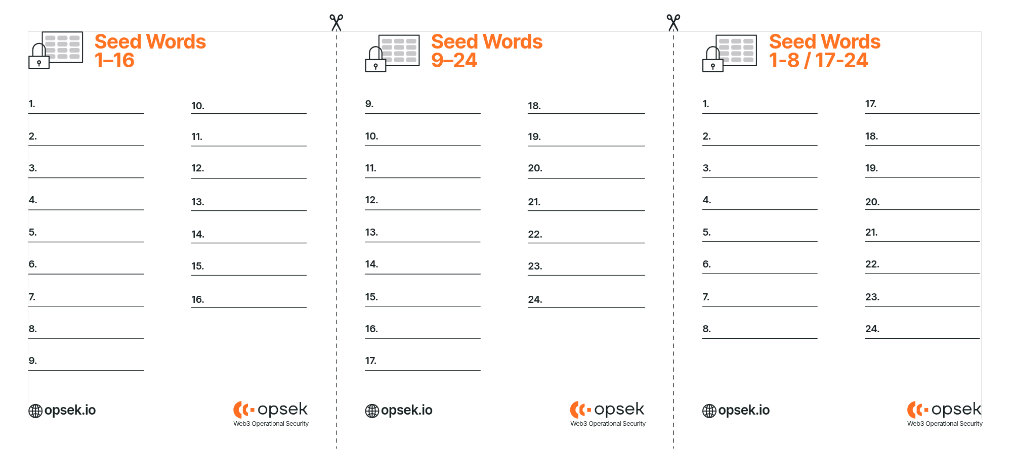
- Split seed backups with SLIP-39. Opsek’s Seed Phrase Sheet splits one backup into shares with a threshold, for example any 3 of 5. Keep the shares in different places, with different people. Fewer shares than the threshold reveal nothing about the seed.
- If you use a passphrase (sometimes called the 25th word), back it up separately and tell your heirs it exists. A seed restored without it opens a different, empty wallet, and heirs may conclude the funds are gone.
- Write the recovery instructions in plain language, for the person who will actually do it. Add one warning in bold: no real exchange, wallet company or recovery service will ever ask for a seed phrase.
- Rehearse once a year with that person and a small amount.
- Write down each exchange's process for deceased account holders, and keep recent statements in the file.
Step 7: Keep the bills paid
Adversary: time.
Privacy makes this step harder. If your utilities are in a trust's name, your subscriptions are paid with a virtual card and your deliveries arrive under another name, your family may not know how to keep any of it running. And for accounts that only your key opens, not even a court order will get your family in.
A bank can freeze a personal account as soon as it learns of a death, sometimes until probate ends. An account with a POD beneficiary pays out and closes. A checking account in the trust's name stays open for as long as the trust operates.
- Make a paper list of every recurring bill: the service, the name on the account and how it is paid. Include what keeps your crypto setup running: email hosting, domains and ENS renewals, password manager, VPN and any node or wallet service you pay for. If the email behind your exchange accounts expires, so does your heirs' way in. Add the rest of the household: property taxes on every home, insurance policies, staff payroll if you have staff, and the annual filings that keep each LLC in good standing.
- Open a checking account in the trust's name and pay the utilities from it by automatic bank debit (ACH).
- Use the trust's debit card for services that only take cards, such as the domain and the email hosting. Replace the card when it has less than a year left.
- Keep at least a year of expenses in that account. The money is usually the easy part; the list is the hard part.
- Write down every virtual card and alias service: how the family funds it and whose name it is under.
Step 8: Plan for incapacity
Adversary: time.
Without the right documents, incapacity can paralyze a family. Nobody has clear authority to pay the bills, relatives disagree about who should, and something as routine as property taxes goes unpaid until it becomes a lien on the home.
A death sets the will and the trusts in motion. Incapacity sets nothing in motion unless you planned for it, and every document below has to be signed while you still have the legal capacity to sign it. Documents to discuss with your attorney:
- A durable financial power of attorney. In the US, most states follow a law known as RUFADAA, which lets you authorize your agent, executor or trustee to access your digital accounts. Ask your attorney to include that authorization.
- A durable power of attorney for health care, separate from the financial one, since you may want different people in each role.
- A living will.
- A HIPAA authorization, so your family can get your medical records; by default, they cannot. Ask whether it should cover your complete record, past, present and future, and which witness rules apply where you live.
Then name one person to pay the bills from day one. And remember that a power of attorney gives your agent authority, not keys: for self-custodied crypto, only the recovery path from step 6 lets anyone act for you.
Step 9: Store the originals
Adversary: the insider.
The rule is simple: everything on paper, in one place, with a sealed copy somewhere else.
- Keep the originals on paper: deeds, titles, account statements, seven years of tax returns, insurance policies, the trusts, the will and the directives. Print anything that only exists digitally.
- Add your crypto tax records: transaction history exported from every exchange, and the cost basis of your holdings. Your executor will need them for your final tax return. In the US, your heirs' basis is generally the value on the date of death, so keep a record of that value too.
- Store them in a fireproof safe at home that your family knows how to find and open. Decoy safes are fine, as long as your heirs can find the real one.
- Leave a sealed copy with a relative who does not live with you: a photocopy in an envelope sealed with tamper-evident tape. The tape does not stop anyone from opening the envelope, but it tells you whether someone did. Swap in a fresh copy every time you update the kit.
- Keep credentials and seed backups out of that safe. Deeds and wills can sit where your family can reach them; a seed share or a complete login to the delayed vault cannot. Store seed shares on metal, in separate places such as a bank safe deposit box or the home of someone who does not live with you.
Step 10: Review it every year
Adversary: time.
Beneficiary forms override the will: the institution pays whoever is named on the form it has on file. That makes an outdated form dangerous. An ex-spouse still named on an employer plan, such as a 401(k) or a group life policy, can collect after the divorce.
- Review once a year, and after every marriage, divorce, birth, death, move, new asset, new wallet or new trustee.
- Update the inventory from step 1.
- Check every beneficiary form against the rest of the plan.
- Confirm the delayed-access account is paid and that every contact still has their hardware key.
- Check that your legacy contacts on Google and Apple are still the right people.
- Check that the trust's debit card has more than a year left.
- Run the crypto drill, and on Liana, refresh your coins before any timelock runs out.
- Swap the sealed copy for a fresh one.
- Repeat the OSINT check on yourself and your family.
When the day comes
If the roadmap is done, the first weeks look like this:
- The person named in your final arrangements document publishes one short notice and nothing else, nothing about crypto appears in public, and someone stays at the house during the services.
- Accounts with POD beneficiaries pay out, the trust's checking account keeps paying the bills, and the successor trustee takes over the trusts without a court.
- An emergency contact requests access to the vault. When the waiting period ends, it opens with every login and 2FA seed your heirs need.
- Your crypto moves through the recovery path you rehearsed, not through a file someone found.
- Your heirs ignore every "recovery service" that contacts them, because your instructions told them to.
- Probate, if there is any, handles only what the trusts missed.
Outside the US
The legal steps change from country to country. In many countries, including much of Europe and Latin America, the law reserves part of the estate for certain heirs, and a trust or beneficiary form cannot override it. Work through steps 3, 7 and 8 with local counsel. The rest of the plan does not depend on the country: death notices are public almost everywhere, insiders exist everywhere, banks freeze the accounts of the dead in most places, and a lost seed phrase is lost in every jurisdiction.
Start this week
You do not need to finish all ten steps at once. Three of them fit in an afternoon:
- Write the inventory from step 1, without balances.
- Ask yourself two questions about every wallet: could anyone recover it if you were gone tomorrow, and could anyone recover it today without you knowing?
- Tell one person you trust that the kit exists, and who they should call.
The rest can follow over the next few months, with an attorney for the legal steps.
Frequently asked questions
What happens to your crypto when you die? Exchange accounts can usually be claimed by your heirs or executor with a death certificate and proof of legal authority. Self-custodied crypto can only be moved by someone with the keys. If nobody has them, the funds are lost permanently.
Can a will pass on crypto? A will can say who inherits your crypto, but it cannot give anyone the keys. Never put a seed phrase in a will, because a will can become public during probate.
Where should I store my seed phrase for my heirs? Not in a single place. Split it into shares with SLIP-39 or use a wallet with a timelocked recovery path, so no single person or location can move the funds alone.
Can my family access my exchange account after I die? Usually, yes, but not right away. Each exchange has its own process for deceased account holders, and it typically asks for a death certificate and proof that the heir or executor has legal authority. Until that process is complete, the account stays frozen. A list of every exchange you use, the email tied to each account and recent statements make the claim much faster.
Should I give my seed phrase to my lawyer? Not the full seed. Anyone who holds a complete seed phrase can move the funds, today, without asking anyone. A lawyer can hold one share of a split backup, or a recovery key that only works after a time lock, and keep the instructions your heirs will need. Legal documents give your lawyer authority; only keys give access, so keep the two separate.
What is a dead man's switch for crypto? It is a mechanism that hands over access if you stop showing signs of life for a period you choose. This guide uses three versions of it: Proton's Emergency Access, which opens your vault if you do not deny a request within the waiting period; Google's Inactive Account Manager, which shares your data after a period of inactivity; and a timelocked recovery path, like Liana's, where a recovery key only becomes valid after your coins sit unmoved for a set time. The risk runs both ways: if you miss the warning, the switch can open while you are still alive, so test it and make sure the notices reach you.
Where Opsek fits
OSINT Research shows what is already public about you and your family: whether your wallets can be linked to your name, what an obituary would add, whether your trustee can be linked to you, and which addresses and relationships people-search sites already hold.
Conclusion
A good inheritance plan works like any other security system: it has an attack surface, it has insiders, and it decays over time. Attorneys handle the legal side. The operational side, who can reach your keys and when, is where most plans fail.
Most families test that system only once, during the worst week of their lives. A death kit lets you test it now, while you can still fix what breaks: a seed nobody can find, a vault that opens too easily, a phone nobody can unlock.
So go back to the question this guide started with. If something happened to you tomorrow, would your family know what to do? If the answer is still no, get in touch for a security review of your plan.
Sources and further reading
Estate privacy and death kits
- UNREDACTED Magazine, Issue #013, "The Complete Death Kit" (IntelTechniques)
Legal basics (US)
- What is probate? (Nolo)
- How living trusts avoid probate (Nolo)
- Is a living trust public? (Nolo)
- RUFADAA: access to digital assets after death (Nolo)
- Egelhoff v. Egelhoff (2001), on beneficiary forms and ex-spouses (Cornell Law School)
- Publication 551, Basis of Assets, on the basis of inherited property (IRS)
Tools mentioned in this guide
- Proton Emergency Access (Proton)
- Inactive Account Manager (Google)
- Add a Legacy Contact and what a Legacy Contact can access (Apple)
- Account recovery with Safe{RecoveryHub} (Safe)
- Liana (Wizardsardine)
- SLIP-0039: Shamir's Secret-Sharing for Mnemonic Codes (SatoshiLabs)
This article is for general information only and does not constitute legal, tax or financial advice. Laws on wills, trusts, probate and digital assets vary by state and country. Before acting on any of the steps above, talk to a qualified attorney in each jurisdiction where you hold assets.