Behind every great security conference is a group of people reading through hundreds of submissions, looking for the talks that will teach the audience something real. At the DeFi Security Summit, that work runs through the Review Committee, which reads every talk and workshop proposal and helps the strongest, most useful research find its way to the stage. It's quiet, detailed work, and it's a big part of why a DSS program is worth showing up for.
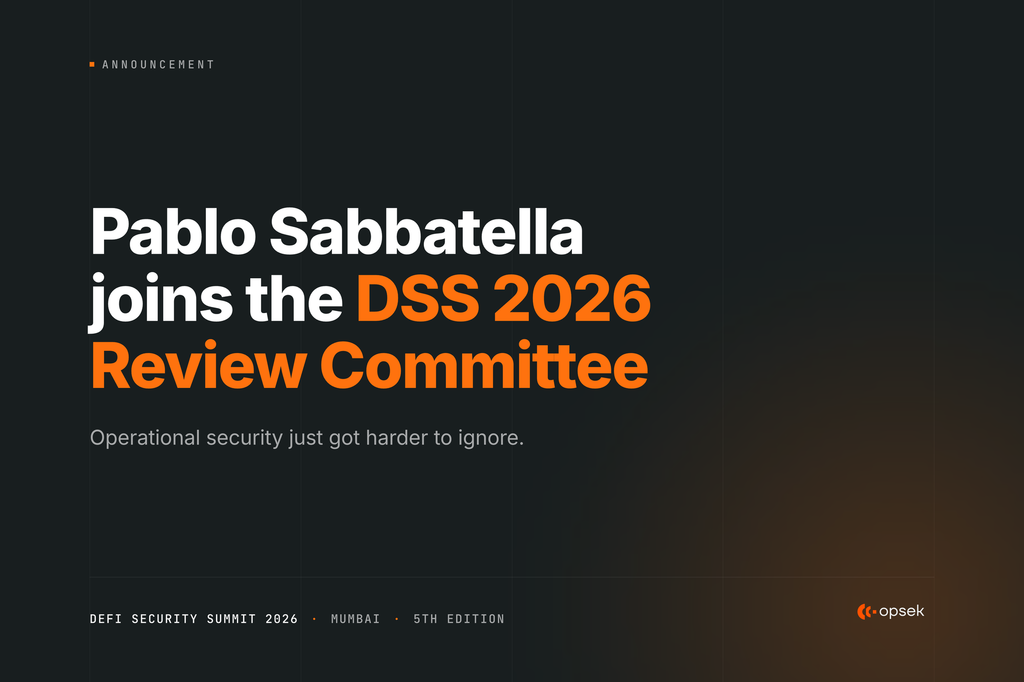
Pablo Sabbatella, Opsek's founder, has joined the DSS 2026 Review Committee. It's a role Pablo takes on personally, and a fitting one: he's been working in DeFi security since its earliest days, back when much of the discipline was still being defined.
If you haven't been to a DSS
The DeFi Security Summit is the annual conference for security researchers, developers, and academics working to make blockchain applications safer, across both their onchain and offchain components. It brings together hackers, protocol builders, and tool providers, and takes its cues from long-running security gatherings like CCC and Defcon: deeply technical, and shaped by the researchers and engineers who work in the field year-round.
Since launching in 2022, DSS has run four editions in Stanford, Paris, Bangkok, and Buenos Aires, growing along the way. The 2025 edition drew more than a thousand builders, researchers, and executives to Buenos Aires during Devconnect week. The through-line across all of them is the summit's own framing: building a safer DeFi, together.
Our part in it
A spot on the committee gives us a chance to push for something we care about: a program that treats the operational side of security as seriously as the code.
Most of the security discourse in DeFi centers on smart contracts: the code, the audits, the formal proofs. That work is essential, and it's well represented at DSS. But a large share of the losses in this industry never touch a contract bug. They come through the operational and human layer: compromised devices, social engineering, poor key hygiene, phishing that turns a routine approval into a drained wallet. That layer is where Opsek does its work, running operational security audits and training for web3 organizations and the individuals who hold meaningful assets onchain.
Having that perspective in the room when the program is being assembled is good for the summit and good for the field. A seat on the committee is a chance to help make sure the operational side of security gets the same scrutiny the smart-contract side has earned.
The work behind the lineup
The committee's mandate is narrow and demanding. Every talk and workshop submission is reviewed by people with real depth in the security space, with the goal of making sure each session is high-quality, insightful, and relevant to the audience that shows up. It's the mechanism that keeps the program rigorous, and the reason a DSS talk tends to be worth watching a year later.
Pablo joins a committee made up of researchers and engineers from across the ecosystem, the kind of people who spend their days on protocol audits, formal verification, and incident response at organizations like Sherlock, Sigma Prime, OpenZeppelin, Runtime Verification, and the Ethereum Foundation. Being asked to help evaluate that work, alongside that group, is a meaningful signal of where we sit in the DeFi security conversation.
What's next
DSS 2026 heads to Mumbai on November 1 and 2, during Devcon week, for two days of talks, workshops, and community work focused on practical DeFi security. Speaker applications are open now, and the program is starting to take shape.
That program is the part we're most interested in. The measure of a good review process is what ends up on stage in November; the research that sharpens how this industry thinks about staying safe. We're glad to have a hand in it.